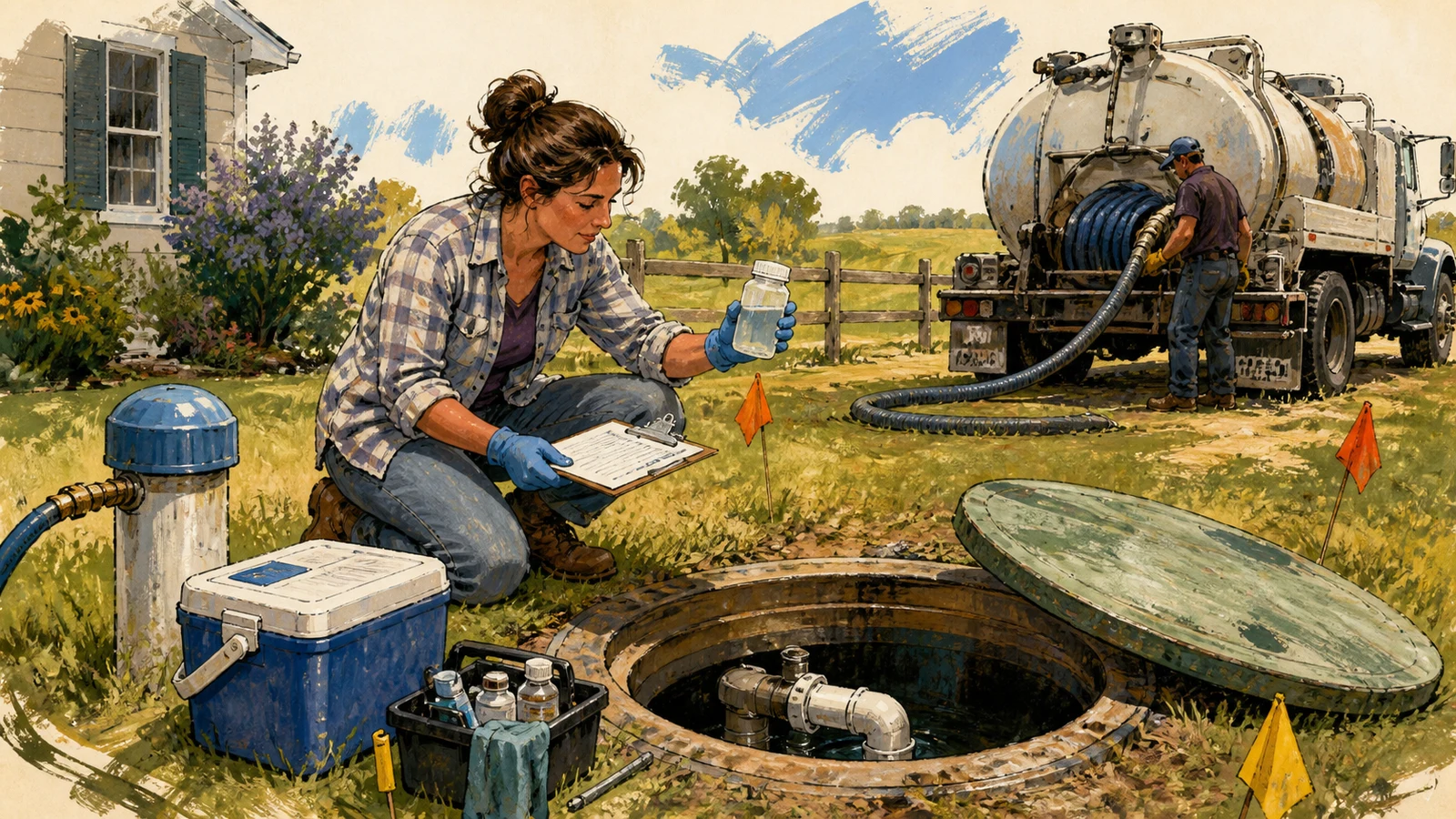
Inspect a well and septic system before you buy rural
A rural property's water and wastewater systems cleared or renegotiated — well water lab-tested for bacteria, nitrates, arsenic, lead, radon, and local contaminants, flow rate and pump performance measured, the septic tank pumped and inspected with the drain field evaluated, county permit and as-built records pulled, and findings converted into a repair request, price concession, or walk-away decision before the contingency deadline.

Free preview: 3 of 19 steps
Work through them in the real run view, exactly as a buyer does. No account, no payment, nothing saved.
3 free unlocks per month — yours to keep forever
No account needed — nothing is saved.
Included with every copy
- Your own copy — keep it forever
- Gets better over time — free updates included
- Run it on web and mobile
- Invite a partner to go through it with you — you share the same progress
- Make it your own — a private copy you can edit to fit your situation
- 2 knowledge checks to test what you've learned
- The playbook's community — ask questions, get additions, and see how other buyers improve it, right on the step
Who it's for
U.S. homebuyers who are under contract on a rural property served by a private well and a septic system and need to complete due diligence inside a typical 10–21 day contingency window.
About this playbook
A homebuyer under contract on a rural property served by a private well and a septic system has a fixed contingency window — typically 10 to 21 days — to find out whether those systems work and are legal, and to act on what is found before the right to negotiate or walk away expires. This guide sequences that work: identify the county or state authority that holds well and septic permits and pull the as-built records, hire a licensed well contractor and a septic professional and book a certified water-testing lab, supervise the flow test, the water sample collection, and the septic pump-out and drain-field evaluation, read the lab report against EPA drinking-water standards, and turn every finding into a repair request, a price concession, or a documented decision to walk away — filed before the contract's deadline. It covers private wells and onsite septic systems only, not municipal water or sewer connections, not radon-in-air mitigation, and not the structural inspection of the house. The county health department, state environmental agency, and contract terms differ by state and county — this guide names the general rule and where to confirm the local one.
Covers 1 situation
Based on the findings recorded below, choose the path forward.
The playbook asks you along the way and shows you only the steps that apply to you.
What you'll do, step by stepFree preview
Only a sample is open: 3 of 19 steps can be read in full. The rest unlock when you buy.
Phase 1: Know the rules and pull the records
5 stepsPhase 2: Hire the licensed inspectors and the lab
3 stepsPhase 3: Run the flow test, sample the water, inspect the septic system
5 stepsPhase 4: Read the lab report and the contractors' written findings
2 stepsPhase 5: Decide and close the file before the deadline
4 steps
Details
What you need first
A signed purchase agreement with an active well/septic (or general inspection) contingency and its exact deadline; access to the property to schedule contractor visits; funds to pay for a well flow test, a septic pump-out and inspection, and a certified laboratory water panel (typically several hundred to over a thousand dollars combined); the seller's disclosure statement if one was provided.
Tags
Common questions
Glossary
- Contingency deadline
- The calendar date in the purchase agreement by which the buyer must complete inspections and deliver any objection, repair request, or termination notice, or lose the right to do so.
- Sustainable yield
- The flow rate, in gallons per minute (gpm), a well can deliver continuously over a sustained test without the water level dropping to the pump intake.
- MCL
- Maximum Contaminant Level — the EPA's legally enforceable health-based limit for a contaminant in drinking water.
- Secondary MCL (SMCL)
- A non-enforceable EPA guideline for a contaminant that affects taste, odor, staining, or appearance rather than health.
- Scum layer
- The layer of fats, oils, and solids that floats on top of the liquid in a septic tank; its depth relative to the outlet baffle determines when the tank needs pumping.
- Sludge layer
- The layer of settled solids at the bottom of a septic tank.
- Outlet baffle
- The fitting on a septic tank's outlet pipe that prevents scum from flowing into the drain field; its distance from the scum layer is measured during inspection.
- Drain field (leach field)
- The buried network of perforated pipes that disperses treated effluent from the septic tank into the soil.