Earn Your FCC Amateur Radio Technician License in Six Weeks
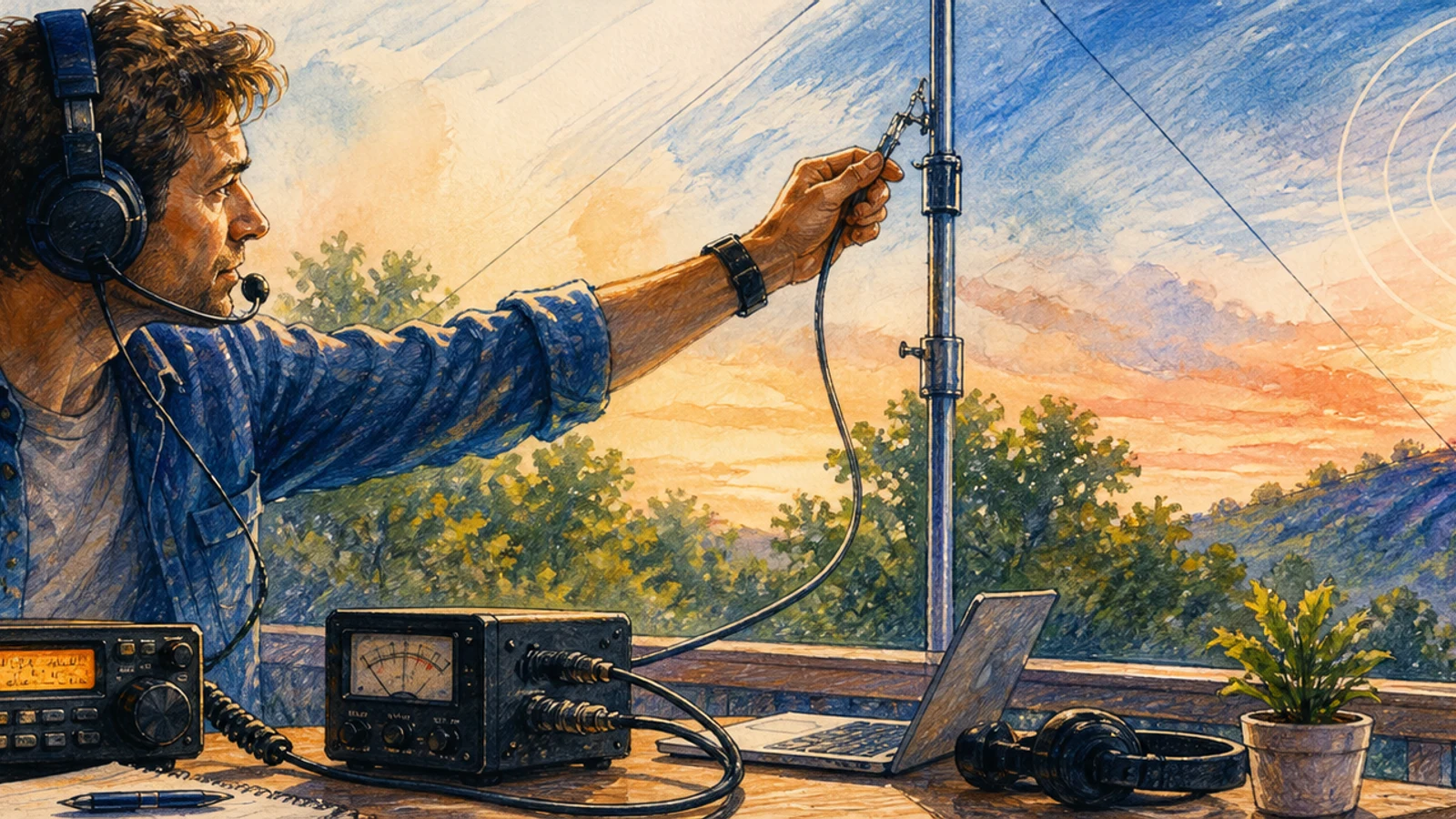
You pass the Technician-class examination, receive your FCC call sign, program a first radio, and complete a supervised local contact while following operating rules.
Free preview: 5 of 27 steps
Work through them in the real run view, exactly as a buyer does. No account, no payment, nothing saved.
3 free unlocks per month — yours to keep forever
No account needed — nothing is saved.
Included with every copy
- Your own copy — keep it forever
- Gets better over time — free updates included
- Run it on web and mobile
- Invite a partner to go through it with you — you share the same progress
- Make it your own — a private copy you can edit to fit your situation
- 5 knowledge checks to test what you've learned
- The playbook's community — ask questions, get additions, and see how other buyers improve it, right on the step
Who it's for
Beginners with no electronics or radio background who want a measurable path to their first FCC license — especially anyone drawn to emergency communications or radio as a hands-on hobby. You should be comfortable with basic arithmetic (multiplication, division, powers of ten) and able to put in about five focused hours a week over six weeks. No equipment is needed until the final phase, after you already hold the license.
About this playbook
The Technician license is the entry point to amateur radio in the United States: one written exam, no Morse code, and full access to the VHF and UHF bands used for local and emergency communication. This guide walks you through the public question pool in six weekly stages, from the physics and rules that make every answer explainable to timed drills that get you to a comfortable pass score. You finish by sitting the real exam, receiving your call sign from the FCC, and making a legal first contact on a local repeater with an experienced operator beside you. Along the way you build a working mental model of radio — frequency, propagation, repeaters, operating etiquette — so the credential rests on understanding, not memorized answers. It does not cover General- or Extra-class study, home station construction, contesting, or advanced digital modes; those build on what you learn here.
Covers 1 situation
Which best describes you right now?
The playbook asks you along the way and shows you only the steps that apply to you.
What you'll do, step by stepFree preview
Only a sample is open: 5 of 27 steps can be read in full. The rest unlock when you buy.
Phase 1: Place yourself and map the exam
3 stepsPhase 2: Rules and station identity
5 stepsPhase 3: Signals, repeaters and propagation
3 stepsPhase 4: Electricity and circuits
2 stepsPhase 5: Equipment, modes and safety
2 stepsPhase 6: Timed drills and booking
6 stepsPhase 7: Exam day and first contact
6 steps
Details
What you need first
You are allowed to take the Technician exam at any age and without U.S. citizenship; you need a stable email address and a legal U.S. mailing address for the license. You do not need any radio equipment, electronics knowledge, or club membership to start. A computer with an internet connection is expected for practice exams, FCC registration, and the remote exam option.
Tags
Common questions
Glossary
- NCVEC
- The National Conference of Volunteer Examiner Coordinators, the organization that maintains and publishes the public Technician question pool. In this guide you check its pool page to confirm the pool dates cover your exam date and that your study materials match that release.
- repeater
- A station that receives on one frequency and simultaneously retransmits on another to extend handheld range across a town or region. In this guide you program its output frequency, offset and CTCSS tone, then make your first contact through it.
- offset
- The fixed separation between a repeater’s output frequency, which you listen on, and its input frequency, which you transmit on. The guide uses 600 kHz on 2 meters and 5 MHz on 70 centimeters as the standard offsets to calculate the input.
- CTCSS
- A continuous sub-audible tone sent with your voice to open a repeater’s squelch. It does not carry voice content and must be set correctly for the repeater to retransmit your signal.
- simplex
- Operation where two stations transmit and receive on a single shared frequency without a repeater. The guide contrasts it with repeater operation and notes 146.52 MHz as the National Simplex Calling Frequency on 2 meters.
- band plan
- An agreed division of an amateur band into segments for different uses such as repeater inputs, repeater outputs and simplex. In this guide you use the 2-meter plan to know where you may transmit and where to listen.
- control operator
- The licensed amateur responsible for the transmissions of a station, even when another person is speaking. The rules require this operator to be present and to ensure proper identification and permitted operation.
- Part 97
- The part of the FCC rules that governs the Amateur Radio Service in the United States. It provides the station rules on identification, prohibited transmissions, privileges and operating responsibilities that the exam tests.
About the creator
Similar playbooks